
Ultimate Guide to Dental Implants
- Ultimate Guide to Dental Implants, what are dental implants, mini dental implants, dental implants made of, dental implants uses, dental implant types, dental implants steps, cost of dental implants in india, dental implants cost in kolkata, dental implants insurance, all on 4-6 dental implants cost, dental implants process and procedure, saftey and risks of dental implants, dental implants safety and durability, dental implants care, ,
- Admin,
What are Dental Implants?
If you have a requirement of dental implant for your missing teeth, you should know first "What is a dental implant"? Defined in a simple word that dental implant is a very minor surgical tooth replacement procedure. By replacing artificial teeth like bridges, crowns, and dentures, the dentist usually fills gaps in the teeth. Besides this, it also helps you to improve facial structure and restore your smile.
But a few days after the implants are placed, they function just like natural teeth. If you take proper care of them, they can last for many years and in many cases, a lifetime. To gain knowledge about “what tooth implants” are, you need to know some basic things.
What are Mini Dental Implants?
The doctor has suggested dental implants for your dental problem, but has also said that your jawbone does not have the bone mass to hold the implant. Or maybe you are afraid of surgery. In this case, only mini dental implants work great.
Don’t let the word ‘mini’ mean it’s not as effective as traditional ones. It’s effective enough, and it also has some extra benefits that you might not get with a traditional procedure.
The word mini implies that they are smaller in size than regular ones, but the structure and function are almost the same. Made with a less than 3 mm diameter one-piece screw and a ball-shaped end, the implants protrude from the jawbone.
They are ideal for people who do not want to go with any invasive approach to the procedure. This process is completed in a single session. So, if you have bone loss or your lower teeth are loose, you should definitely go with this procedure.
What are Dental Implants made of
You should know every single piece of information about it, along with what dental implants are made of, before starting the process. The materials used for it are discussed below.
- Titanium – A most commonly used material in dental implants, which promotes bone integration very quickly and perfectly. It is also much more affordable than other materials. Just one week after implant surgery, the bone slowly fuses with the titanium post. According to the report, the success rate of titanium and titanium alloy-made implants is 95% than that of other materials.
- Zirconia – The dental implants made with Zirconia are newer than those made with titanium. Their success rate is also around 80%. It has been proven that these implants are essentially more effective for patients who are allergic to titanium, which is placed in just one session. However, its disadvantage is that it is more difficult to insert into the tooth than titanium ones.
Which dental implant material is right for you depends on your oral health and needs. This can be assessed by an experienced implantologist in Kolkata, India.
What are Dental Implants used for
Dental implants have many uses and benefits:
· Tooth Replacement: It is the process through which artificial teeth are replaced. It is a highly effective procedure that securely anchors the artificial tooth in place. Though it is artificial teeth, these are durable and long-lasting alternatives.
· Bone Preservation: In some cases, the jawbone becomes weak after losing a tooth. You can prevent it with a tooth implantation by stimulating the bone.
· Improved Oral Function: With the procedure, you can restore your chewing capacity if your chewing capacity is lost after jawbone deterioration.
· Long-Term Solution: The success rate of this procedure is more than 97%. which serves as a long-term solution.
· Preserve Adjacent Teeth: With the success process, your adjacent teeth cannot be affected.
· Versatility: With minor surgery of the dental implant process, a single tooth can be replaced. For multiple tooth implants or a complete set of teeth, dentists use a bridge.
Here are the advantages of the implant mentioned below
· Durability: Now, titanium ones are one of the most recognized alternatives as its standard and affordable features. Besides these, it is also a long-term option compared to others.
· Bone Health Preservation: There is a misconception that this is a procedure to implant artificial teeth in place of damaged natural teeth. However, researchers report that this process stimulates the jawbone and firmly anchors the teeth in the jaw. Furthermore, it is highly effective at preventing bone shrinkage that occurs after tooth loss.
- Facilitate all activities of teeth without difficulty: This method helps to anchor the teeth to the jaw very firmly and securely. So, it allows the users to do every type of work, such as eat, speak, and engage in all other activities.
- Helps maintain a natural appearance: It is a process where the fundamental structure of the teeth cannot be changed. The implant integrates properly. So, your natural smile and facial structure cannot be affected—your smile is fully restored. So it can boost your self-confidence.
- Protects adjacent teeth from weakening: It is an advanced procedure compared to dental bridges. This procedure does not need grinding down adjacent teeth. So, your healthy teeth are maintained properly.
- Convenience: This surgical process also offers convenience. The Dentist in Kolkata usually avoids using any adhesives or special cleaning products during the treatment process.
What are the Types of Dental Implants?
They are available in three categories:
Namely:
· Endosteal,
· Subperiosteal, and
· Zygomatic.
Of the three, the endosteal method is the most highly recommended option, as it is both the most common and the safest procedure.
1. Endosteum Implants
This is the most commonly used process, where a post, which looks like a screw, is anchored into the specific area of your jawbone, where the artificial teeth are implanted. Before going with the process, you should be aware that your jawbone needs to be strong and healthy, so the post can integrate securely.
2. Subperiosteal Implants
With a surgical procedure, these are positioned directly on the surface of the jawbone, situated beneath the gum tissue. The posts, used to attach the artificial teeth in this process, extend outward through the gums. To anchor these posts, the doctor installs a metal framework beneath the gum line. Once the gums have fully healed, the framework becomes securely fixed in its designated position.
3. Zygoma Implants
These are different from others because the posts are implanted within the cheekbones rather than the jawbone. The remaining part of the process is the same as the other two.
What are the steps for Dental Implants?
They are widely regarded as an effective solution for restoring missing teeth. Most dentists or oral surgeons recommend this process to patients who want to recover their natural smile. Before starting the treatment, it is extremely essential to understand every step of the process.
· Consultation and Assessment with a skilled Dentist
The initial step of the treatment is consultation with a skilled and experienced dentist or oral surgeon, who will evaluate your oral health. Then will advise you on whether the treatment is suitable for you. During this evaluation, they will take X-rays and gather your medical history.
· Proper planning and strategy of the Treatment
The dentist will discuss every important information about the dental implant with you at that time, when he or she thinks you need the treatment immediately, including the type, number, steps, time, and cost of the treatment plan. In addition, you will be informed of the specific implantation strategy designed to meet your needs and requirements.
Surgery for Implant Placement
This procedure involves surgery, wherein the implant is positioned within the jawbone, beneath the gum tissue. To minimize patient discomfort, the procedure is carried out using local anaesthesia or sedation dentistry.
Osseointegration
The step immediately following the placement is osseointegration. This stage is time-consuming, as it requires a several-month waiting period to allow the implant to integrate with the jawbone fully. This integration process endows the artificial teeth with both durability and stability.
Attach an Abutment
The surgical process needs enough time to integrate with the jawbone. To make a smooth connection with replacement tooth or teeth, the dentist uses an abutment to the implant, after the integration, such as a bridge, denture, or crown. These components effectively ensure that the teeth seat firmly and securely."
Placement of Restoration
After all steps of the procedure, a custom-made dental restoration needs to be placed onto the abutment, which are available according to the shape, size, and color of your natural teeth
At the last step of the treatment, the doctor uses a dental restoration that is designed according to the size, shape, and color of your natural teeth. It is placed onto the abutment.
Follow-Up
The last step is follow-up, where you need to visit the surgeon for follow-up. It assures you don’t have any complications and the implant is functioning properly.
Are there any other options for dental implants?
• Below, we are discussing some alternatives:
Same-day teeth
True to its name, Same-Day Teeth is a specific technique of implant. In this procedure, the dentist or oral surgeon extracts the patient's existing tooth and immediately inserts the dental screws into the same socket. For this reason, the method is also known as immediate placement.
One might wonder how it integrates with the bone; the answer is that it gets primary stability via an external threading mechanism. Through this process, it also achieves secondary stability.
Due to the achievement of primary stability, the surgeon can easily place the abutment onto it, thereby making it possible to replace the teeth using a dental bridge or denture. Utilizing this restorative method, it is possible to replace multiple teeth using up to six implants.
2. Cost of Dental Implants in India
Information about the cost
If you have missing teeth, you may lose your self-confidence in your physical appearance. To maintain oral health and the functionality of the teeth, most of the individuals facing tooth loss now go with the permanent process, which creates a revolution in the restoration of missing or lost teeth. Before going with this process, you should know what the charges for a dental implant are. The cost for a single one is between 20,000 to 50,000. If you want to go for full mouth restorations of the entire set of teeth in your mouth, you should pay around 400,000 to 800,000 .
The information about the cost of dental implants in Kolkata
If you are staying in Kolkata and want to go with the procedure to restore your missing teeth, then you should know this process is relatively more affordable than other metropolitan cities of India, like Mumbai, Delhi, Bangalore or Hyderabad, estimated at 20,000 to 50,000. But, sometimes the costs may fluctuate for various factors, including the patient's physical health, the treatment process, the equipment used, the reputation of the dental clinic in Kolkata, and so forth.
Types of dental implant costs
- You should pay for a single--20,000 Rs to 50,000 Rs
- Cost of Multiple tooth--70,000 Rs to 1,25,000 Rs
- Price of All-on-4 per arch--1,60,000 Rs to 3,00,000 Rs
- Full mouth reconstruction price--4,00,000 Rs to 8,00,000 Rs
- The price for All-on-6 per arch that you need to pay approx 2,50,000 Rs to 4,50,000 Rs
- The cost of the it made with Zygomatic is 80,000 Rs to 2,00,000 Rs
The information about the new teeth price in India in comparison to USA, UK or UAE.
The price of it is typically lower in India than in other countries, ranging between 20,000 and 50,000. Sometimes this cost may vary due to different factors. These are discussed below
- Implant Brand, Material & Type: There are some Premium implant brands—such as Straumann, NobelActive, and AB Dent. The cost of these implants is significantly higher due to the quality. The advantages of using these systems is, it offers much faster healing and enduring results. However, if you opt for a standard-grade system, the cost will be somewhat lower.
- Weak jawbone or low bone density: You should go with a graft or sinus lift if you have a weak jawbone or low bone density. Then your procedure can be successful. This can increase the cost of the treatment.
- Surgeon’s expertise: If you choose expert Implantologists in India for your procedure, the cost of your implant becomes higher than that of a normal implant.
- Type of Prosthesis (Crown or Bridge): If you prefer dental crowns or bridges made of ceramic, zirconia, or metal-ceramic, the cost of the process increases.
- Technology & Location: The charges of the Dental Clinic in India with updated technology, such as 3D scanners, CBCT imaging, and guided surgery is more than those of a normal clinic.
The information about the cost of Dental Implants with Insurance?
Insurance is another factor that influences the cost of dental implants. In general, the cost of it does not come under the insurance coverage and its very rare in India. Generally, insurance does not cover the cost of replacing missing teeth, as these are identified as an 'optional or cosmetic dental or medical procedure for most insurance companies.' But the cost of it like crown typically comes under insurance policies, so you need to consult with your insurance company before the surgery. But in many developing countries like USA, UK dental insurance covers dental procedure.
Comparison of dental implant cost with other countries, the USA, England, the Middle East, and Australia
It is mentioned on a report published in 2026 that the cost of dental or teeth implants in the United States, England, and Australia is comparatively higher than in India. Labour costs, operational and establishment expenses for the dental clinic are also comparatively higher. However, in the Middle East (particularly Dubai), Dental implant pricing is affordable and diverse in the Middle East, particularly in Dubai than in Western nations. You can find the lower-cost, different types of mid-range implant options here.
Dental Implant Cost Comparison (Single Tooth, 2026)
In the USA, you need to pay $3,000 – $6,000 for a single tooth implant
In Australia, the cost of a single tooth implant-- AUD 3,000 – AUD 6,500 ($1,900–$4,200 approx)
You should pay £2,000 – £4,500 ($2,500–$5,500 approx) for a single tooth in an implant in England
In the Middle East, the price is comparatively low, $1,000 – $4,000 (AED 3.5k–10k) for a single tooth
How much do all-on-4 dental implants cost
If you are staying in India and want to go with 'All-on-4' dental implant treatment for your teeth restoration, it is expected to pay between ?150,000 and ?400,000 per jaw (arch). This cost may be high or low depending on different factors such as the clinic's location, the brand of implants, the tools and technology, and the expertise of the dentist or oral surgeon. It is a unique procedure—completed within a day. So, the cost is higher than a typical dental implant.
How much do ceramic dental implants cost?
There is another category of dental implant, named ceramic (zirconia) dental implants. It is an expensive alternatives than other dental implants, priced at ?50,000 and ?90,000 per tooth. In all over the world, the price of these implants is higher than that of conventional titanium implants due to the premium cost of the material.
3. Procedure and Process
How are dental implants done?
It is a very minor surgical process for tooth replacement. You can replace one tooth or the tooth of the whole mouth; the process is the same. The screw is placed on the jawbone to provide support for artificial teeth, including bridges, dentures, and crowns. It is a time-consuming process that can take several months of healing. An artificial tooth can be used as a natural tooth and gain all the functionality of the natural teeth, such as chewing.
Here are the three main parts:
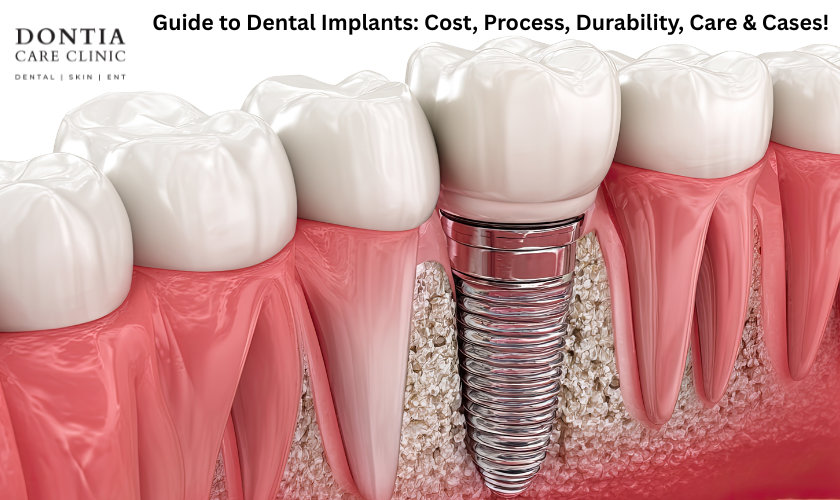
· Threaded post: This post offers a foundation for the artificial teeth, which act like a root of the implanted tooth. With an oral surgery, it is placed on the jawbone. You have some time to integrate the post with the jaw.
· Abutment: A small connector post that connects the post with a screw and extends slightly beyond the gums. It works as a foundation for the artificial tooth.
· Restoration: A dental restoration is actually the process of repairing or replacing teeth. There are some commonly used restorations named crowns, bridges, and dentures.
Titanium is the most used material for , and it is also an affordable option. Sometimes, ceramic is also used for the post. All these materials are biocompatible and quickly integrate with the jawbone.
With missing teeth, your oral health can be affected. Not only that, it can destroy your self-confidence. So, your mental and emotional well-being will be affected. So, the question is how you can avoid the situation? The answer is the surgical treatment which is the perfect solution for you that can help you restore your smile as well as your confidence.
The surgery is not the same for everyone. It can be personalized according to the requirements of the patients.
· The dental implant periodontist places it on your jawbone with an oral surgical process.
· Invest enough time to integrate with Jawbone
· After completing the process, attach the post with a crown, bridge, or denture.
How are dental implants put in
It is a minor surgical process where a titanium post is inserted into the jawbone of the patient. This post acts as a tooth root. Then you need to wait for 3-6 months for osseointegration. It is a healing period. In this surgery, the surgeon cuts a hole to reach the jawbone with updated tools, then the implant is screwed into the jawbone and stitches the gum. After that, you have to give 3 to 6 months for the integration of it with the jawbone, then the abutment will be attached to the jawbone, and a crown or artificial teeth will be attached.
How do dental implants work?
The main work or primary benefit of it is to replace your missing tooth. Here, the biocompatible, screw-like posts made with Titanium are surgically placed into the jawbone. After placing it, you should give 3 to 6 months for it to integrate with the jawbone; the name of this process is osseointegration. When a dental surgeon confirms integration, he or she attaches an abutment and also places the custom prosthetic crown. It functions like a natural tooth.
How to implant teeth
This is not a one-phase treatment. It involves a multi-stage process. Here, the tooth doctor placed a titanium post with a minor surgery. This post acts as a tooth root. Then, you need to give at least 3 to 4 months for integrating it with the jawbone. It is actually a healing process for bone fusion known as osseointegration. When a surgeon determines to complete the restoration, then he or she attaches the abutment and places the custom crown on the top. But this process can be done successfully if the patient's bone health is perfect.
How long is the dental implant process?
If you have a missing tooth, the most effective treatment is this placement procedure. It is actually the replacement of artificial teeth that is secured stably. As with this process, you don’t have the fear of bone loss, and it functions like normal teeth. Due to Osseointegration or integration of the screw with the jawbone, the treatment becomes longer than other alternatives. The total time of the dental implant varies based on a variety of factors, that ranges from 3 to 6 months.
How long do dental implants take to heal
Recovery of it usually takes 10 days for soft tissue healing. But you have to wait 3–6 months for osseointegration or integration with the jawbone. You may feel mild discomfort and swelling after the treatment process, which can be removed within 24–72 hours. The total treatment, from consultation to permanent crown placement, typically takes 3 to 9 months. This time may vary person to person depending on the bone health of the patients.
4. Safety and Risks of Dental Implant
They are artificial teeth, which is why they are recommended for those who have missing teeth. It is also required for someone who wants to remove and replace his or her teeth.
You have to invest enough time to complete the multiple steps of the procedure. It is a long-term process and takes approximately 3 to 6 months to complete.
Are dental implants safe?
Yes, it is a secure treatment plan for most of the patients. You can enjoy the long-lasting benefit of the treatment plan. However, it is not safe for everyone. There are some reasons that you need to explore another option.
If you are assessed as a suitable candidate for dental implants, then the dental surgeon usually recommends a further treatment plan for the treatment.
It is also an approved option by the Food and Drug Administration (FDA), in the United States. While evaluating and approving its material, the organization tries to follow international standards.
Do you indeed feel pain during the dental implant surgery?
This is a minimally invasive process. It is proven that not all surgery leads to trauma and fear. During the surgery, you should not experience any pain as the mouth will be numbed with local anaesthesia. After the numbness wears off, you may experience a little bit of pain in the gums and the jaw after the surgery, which is normal.
In this situation, most dental professionals provide pain medication or a painkiller to manage the pain and discomfort on the operated portion of the mouth. But the pain may disappear within 10days of the surgery. You can feel less discomfort with a single implant than with multiple ones.
It is important to contact a dentist or a dental surgeon immediately. If your discomfort or pain persists after the 10 days in the operated area. Prolonged pain can be a sign of infection at that part.
Do dental implants hurt
Though more complicated than other alternatives, they are not too painful. The surgery process is done under adequate anaesthesia and uses all modern and updated pain management techniques. So patients usually do not experience much more discomfort and pain than conventional tooth extractions or fillings
Can diabetic patients undergo the dental implant treatment?
Yes, the treatment process is completely safe for diabetics.
If the patients have diabetes, they must be careful while deciding to undergo the dental treatment. It needs to be remembered that diabetes must be in control before starting the procedure.
It is proven that high blood sugar levels can slow down the healing process in the human body and make the condition more critical.
According to the experienced dentist, well-managed diabetes cannot rule out the process. There are lots of examples of diabetic patients who safely completed the treatment process. If you have diabetes and need to undergo the treatment for your missing teeth, you have to discuss your health condition with your dental doctor.
5. Longevity and Durability of dental implant
Dental implants are considered the best and most perfect alternatives for missing tooth replacement. The main advantage of a dental implant is its longevity.
The life span of dental implants:
They may last 20 to 30 years minimum. For some users, it may last for a lifetime. No other alternative has this life span. While getting the treatment, you need to invest enough money to restore your missing teeth.
What is the life span of dental implants?
For replacing our missing teeth, it is considered the best alternative due to its durability and longevity. These are designed to last life long and to function just like natural teeth. That’s why implant posts made with titanium or other materials need sufficient time to firmly integrate with the jawbone and the surrounding bone tissue—this process is known as osseointegration. It works like a tooth root.
Even though they are permanent, the crown is not necessarily permanent. You may replace it after 15 to 20 years. Approx 50 to 80 percent of the crown needs to be replaced.
Can dental implants last forever?
With perfect maintenance and care, they may last for life long. You need to have sufficient healthy bone in your jaw for getting proper support for the implants. If the dentist assesses the low bone density in your mouth or you have any experience of bone loss, then he or she usually advises you to undergo bone grafting before the dental implant.
Though the titanium post and abutment can be a lifetime alternative, the crown is not long tasting alternatives that needs to be replaced after 10 to 15 years, depending on several important factors.
The location of the tooth:
During chewing or biting any type of food or objects, most pressure is usually borne by the teeth at the back of the mouth. So, these teeth need to be replaced sooner than the teeth at the front of the mouth.
The material of the crown:
Different types of materials are used to make the crowns including ceramic, resin, or metal. Not all are similarly durable. Some of them are longer-lasting than others. It is tested that Porcelain crowns are the gold standard.
General oral health.
Gum disease can destroy your artificial teeth. Therefore, you are recommended to brush twice in a day as well as floss regularly with alcohol-free antiseptic mouthwash to prevent bacteria and.
Any type of Pre-existing medical conditions:
If you have any medical condition, such as diabetes and compromised skin, don’t leave it untreated, as it can be vulnerable to infections and become a threat for your implants.
Tobacco consumption or smoking
It is important to avoid smoking and using any tobacco products if you have dental implants or want to undergo the treatment. Smoking not only stains your teeth; it can disrupt blood flow and lower the oxygen level, so, additional oral complications can be created. Moreover, it can increase the chances of plaque in the mouth.
There are some basic common-sense rules that you need to maintain, for instance, avoid chewing hard foods and objects such as ice, hard candy, etc. These can place excess strain on your crowns and cause them to break prematurely. If you maintain the basic precautions and care every day, you can enjoy the maximum lifespan of your implant.
6. How to care for dental implants
You need to take proper care to maintain the implant lifelong. To make it long-lasting and durable, Dentists or dental professionals usually advise following proper care after completing the dental implant process.
Brushing and flossing at least twice daily, carefully and thoroughly, are extremely important to clean the implants as well as the surrounding gums using a soft-bristle toothbrush or an electric toothbrush. So you can maintain your teeth for a long time, even for a lifetime.
Debris and plaque between the crown or implant site may destroy the whole process. Flossing the dental implant daily with implant-specific floss or water flossers helps you to remove the debris and plaque from the implant site.
How to floss dental implants
Daily flows are very important to make the dental implants long-lasting. If you use the specialized, thick "super floss" or floss threaders, it works really great to remove the plaque and prevent the disease like peri-implantitis. After taking the floss in the mouth, rather than up-and-down, you should guide the floss around the implant in a C shape. It helps you to clean the concave area and joint of the implant and gum.
How to heal faster after dental implants
If you want to get faster healing after completing the dental implants, you need to take rest for 48–72 hours, apply cold compresses (20 min on/off) on the implant site for removing the swelling, and maintain perfect oral hygiene.
How to prevent infection after a dental implant
Bacterial infection can destroy the dental infection. To avoid infection, it is important to maintain your oral hygiene daily. You should brush your teeth twice daily and floss regularly, which protects you from dental infection. Try to avoid regular smoking, quit alcohol intake, and follow the post-operative instructions properly to maintain your oral hygiene effectively. You should take liquid and soft food after completing the dental implant process.
Eating habits after dental implant treatment
After completing the dental implant treatment, you have to take soft, cool foods, including smoothies, yoghurt, mashed potatoes, cottage cheese, and different types of soups.
Things that you need to avoid after dental implants:
A dental implant is cost process. So, you need to focus on maintaining the dental implant for a long time. Try to avoid biting or chewing any hot, hard, crunchy, spicy, and sticky foods at least first 1-2 weeks of the implant treatment. This is one of the keys to getting faster healing. Besides this, you need to quit smoking and alcohol. Don’t go with straws and vigorous physical activity for the first 1-2 weeks of completing the treatment; if you do it, there will be a chance to disrupt the surgical site. Tp keep the dental implant lifelong, you should focus on proper cleaning and caring. The dental implant is considered the best alternative due to its durability and longevity for replacing missing teeth. It looks and functions like a natural tooth.
7. Special Cases and Considerations of Dental Implant
Can sugar patients get dental implants?
Though there are some challenges for sugar patients, they can easily go with the treatment. But before starting the process, they have to consult their doctor as well as their dentist regarding the challenges, the medicine of your health condition.
Do you undergo the dental implant treatment with receding gums?
Gum recession may create different dental health issues, along with the loss of gum tissue. With this dental condition, the treatment can fail.
In dental implants, posts are anchored directly into the jawbone and gum tissue, as it functions like tooth roots do. If you don’t have enough gum tissue or have low bone density, the risks of failure can be increased. You cannot be a suitable candidate for it if you have severe gum recession. Luckily, Gum recession patients can undergo the treatment with the advancement in dentistry.
Can dental implants be done in one day?
You can go with “same-day dental implants” if you are in a hurry or facing serious dental challenges. It becomes successful for those candidates who have enough bone density to support the implant. Not only that, but candidates must have good oral health without any gum disease.
Can dental implants be removed?
They can be removed if you face any problems after completing the process. The removal process becomes easier if the implant post has not integrated with your jawbone. In this process, dentists need to put you under anaesthesia, so it will be easy to remove the crown, the abutment, and then the actual implant itself.
Can dental implants be replaced?
The longevity and durability of a dental implant depend on proper care and maintenance of the artificial teeth. It is observed that the crown may crack, or a component of it may fracture due to an accident or after biting something hard.
Some individuals grind their teeth, which is a great enemy for dental implants, as bruxism might be developed on the teeth, which leads to microscopic fractures on the crown. With time, this crack becomes wider. It may lead to the replacement of your artificial teeth.
If any patients have malocclusion, then achieving a successful procedure will be very difficult for him or her. As the top and bottom teeth do not fit together in this dental problem, it leads to wear away of the top of the crown. Gum tissue recession is another big issue that also leads to the replacement.
With the above-mentioned issues, the implant needs to be replaced. These problems may occur when users do not maintain or care for their artificial, including avoiding brushing regularly, flossing, etc.
Can dental implants change the shape of the face?
A patient may face a problem like a change in the facial structure, which may happen due to the loss of bone growth or missing teeth. The dentist can restructure your face with the surgery. Placing the artificial teeth can improve jaw health and posture, by which facial structure can be restored.
8. Insurance and Coverage of Dental Implant
Does dental insurance cover implants?
Most insurance companies do not cover the cost of the treatment in India. This process is classified as cosmetic or elective. But there are some insurance plans that offer partial coverage with riders. If you lose a tooth due to an accident, injury, or serious illness, the cost is highly likely to be covered by insurance. Some of the insurance companies exclude the cost of it, but offer the price of the crown or abutment. It depends on the insurance plan that you choose.
Are dental implants covered under health insurance?
Typically, the cost of it does not come under most of the health insurance companies. However, if you lost your teeth due to a catastrophe, then the dentist recommends a dental implant for missing teeth, depending on the chosen coverage.
If you want to claim the insurance cover of the treatment, you should fulfil the following conditions
Coverage Limit
You are allowed to use a specific portion of your insurance coverage amount for it. For example, if your total insurance coverage extends up to ?5 lakh, you may be eligible to receive between ?2,500 and ?3,000 for the treatment, which is very nominal.
Waiting Period
If you need to undergo surgery due to any accidental injury, then you do not need to wait, as the cost of it due to accidental injuries is usually covered from the first day of the treatment.
They are usually considered cosmetic surgery, so the cost of this treatment is not covered by Original Medicare (Parts A & B). But some private Medicare plans cover the expenses of the implant fully or partially
How to get dental implants covered by medical insurance
Here are the steps to Coverage:
· Prove Medical Necessity: You need to submit a report from your dentist or dental surgeon to the insurance company. This report is important as it can demonstrate the necessity of the implant.
· Utilize Medical Savings: It is important to utilize a Health Savings Account (HSA) or Flexible Spending Account (FSA). It helps you to pay for it with pre-tax dollars, which allows you to save roughly 30%.
· Add-on Riders: It can be a smart decision to purchase the specialized dental insurance riders or policies, as these types of plans cover major restorative procedures.
· Negotiate Partially Covered Items: Some insurance plans exclude the cost of the post, but they offer the cost of the crown or abutment.
Why aren’t dental implants covered by insurance?
Most of the insurance companies exclude the coverage of the treatment from their plan, as this treatment process is classified as an elective or cosmetic procedure, and it does not come under the medical necessity. Most dental insurance coverage has low annual limits, so most of the organization does not offer coverage of the high cost of implants. Some companies exclude the cost of it but offer the price of the crown and abutment.
9. Miscellaneous
Can a person with dental implants have an MRI?
According to the doctor and dental professional, it is completely safe for MRI scans. They are made with non-ferromagnetic materials such as titanium and zirconia. These products are safe for the magnetic fields of MRI and cannot interact. Although it poses no safety risk, it may cause minor, localized image distortion.
Do dental implants affect a CT scan?
CT scans are completely safe, including specialized CBCT scans with dental implants. The post made of titanium and zirconia does not cause any problems during the CT scan. With its material, minor "metal artifacts", an image interference will be created, but a dental professional can minimize it and create a high-quality image of the jawbone by using the advanced technology.
Do dental implants feel like real teeth?
Yes, they look and function like real teeth after completing the treatment. For daily use, you will be unable to distinguish these from natural teeth. Anchored into the jawbone, you can get a stable, comfortable, and permanent solution with the procedure. So, normal chewing and speaking without clicking or slipping becomes easy with the artificial teeth.
Are dental implants noticeable?
Usually not noticeable, they are designed to look, feel, and function like natural teeth. The artificial teeth are anchored into the jawbone with a screw securely and firmly. You need to give sufficient time to fuse the post with the jawbone.
- dental implants recommended for diabetics
Though there are some challenges for diabetics, they can easily go with dental implant treatment. But before starting the process, they have to consult their doctor as well as their dentist regarding the challenges, the medicine of your health condition.
Are dental implants considered cosmetic?
No, they are not just considered cosmetic; mostly, it is known as restorative dentistry. This treatment can restore the functionality of natural teeth with implanted artificial teeth, such as biting, chewing, and speech. Improving the appearance of a smile, it offers the functional and structural benefits to your dental oral health. These are the main reasons to consider the restorative procedure.
Are mini dental implants permanent?
Mini dental implants are a permanent and long-term alternative that you can choose for replacing teeth. This implant can last for 10 to 15+ years if you maintain it properly. They are anchored with titanium screws to the jawbone, but it is not completely permanent and has a higher risk of failure than traditional implants.
Are same-day dental implants safe?
If you are a suitable candidate with good bone density, then you can go with Same-day procedure, which has more than 95% success rates. If you want a faster recovery or immediate tooth replacement, then the treatment needs high-precision planning. It has a risk of failure if it is implanted incorrectly. This is perfect for the front teeth.
Are dental implants magnetic?
No, the material of it is titanium or zirconia, non-ferromagnetic materials. So, it does not react to the strong magnetic fields. These materials of implant are safe, and there is no risk of discomfort and movement during imaging.