
What Are the 3 Types of Dental Implants? A Complete Guide to Choosing the Right Option
- 3typesofdentalimplant, endostealdentalimplants, Subperiostealdentalimplants, Zygomaticdentalimplants ,
- Admin,
In any person’s proper oral functioning, teeth play a key role, and their impact is not limited to the quality of a smile. For example, a person who has lost a tooth may find it difficult to properly chew food, speech may be affected, and the appearance of the face will also start deteriorating. All of these collectively will start making a gradual change to the individual’s jawbone.
However, with the advancement of modern dentistry, these are not considered to be a severe crisis. Dental implants are now one of the various remedies that can be successfully used for replacing missing teeth and are extensively used for appropriate patients. While researching the scope of replacing teeth, it may appear in your mind: What are the three kinds, and which one is suitable for you?
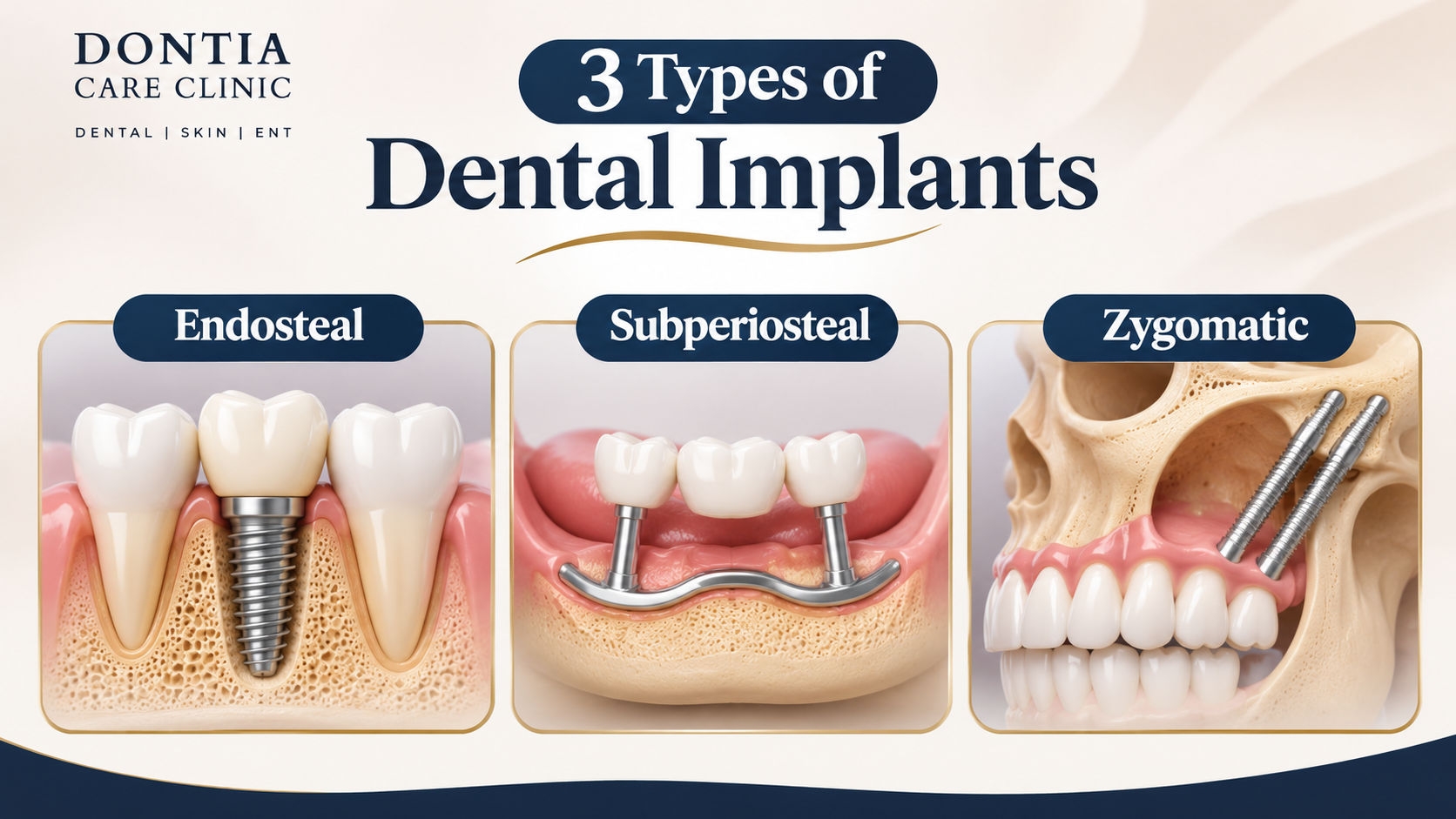
Well, these are called endosteal, subperiosteal, and zygomatic. Each of them possesses a unique placement method, clinical application, and suitability that are based on the jawbone condition of a patient. This guide will focus on the work carried out by Dontia Care Clinic-Dental concerning dental implants.
What Are Dental Implants?
These can be used to support replacement teeth. They are artificial substitutes for natural tooth roots that can be used to replace missing or damaged natural tooth roots. They provide a strong, stable foundation for crowns, bridges or dentures supported by implants. Most of them are constructed from titanium – a biocompatible material.
This allows them to bond naturally to bone tissue within the jaw, and the healing progression is termed osseointegration.
A usual restoration will consist of 3 parts:
- Fixture – A small post that is either inserted into or supported by bone tissue in the jaw. Acts as an artificial tooth root.
- Abutment – Connects to the implant and provides support for the replacement tooth.
- Crown/Prosthesis – The visible part of a dental implant. It replaces the missing tooth/teeth.
They can be used to replace one or more missing teeth or to provide full arch tooth replacement.
What Are the 3 Types of Implants?
The three commonly known types are:
- Endosteal
- Subperiosteal
- Zygomatic
Now let us take a closer look at these different types;
1. Endosteal
They are the most common ones used today. They are inserted into the jawbone and act as an artificial root for your teeth. They are usually screw-shaped and commonly made from Titanium.
How do Endosteal Implants work?
You will typically go through the following process:
- Initial Consultation – Your dentist will examine your teeth and gums.
- Diagnostic Imaging – You may be asked to have some dental X-rays or a CBCT scan to help determine how much bone you have and its density. This can also help determine the location of any important anatomical features.
- Implant Insertion – It is surgically inserted.
- Healing – It is allowed to heal and osseointegrate.
- Abutment Insertion – An abutment (connector) is inserted.
- Final Restoration – A bespoke crown, bridge, or denture is fitted.
The healing time can depend on the individual, the type of implant, and your treatment.
Benefits of Endosteal
- Provides stable support for your replacement teeth.
- Can replace one or more missing teeth.
- Looks natural.
- Helps retain the ability to chew.
- Will integrate with the jawbone if it heals well.
- Can be used to support various dental restorations.
2. Subperiosteal
They are placed above the jawbone but below the gum. They differ from endosteal as they are attached using a custom-designed metal frame on the surface of the jawbone. The frame includes posts that pass through the gums to attach the replacement teeth. They may be considered for some patients with severe jawbone loss.
How does Subperiosteal Work?
The general process involves:
- Clinical examination: Your dentist will examine your jawbone and gums.
- Framework Design: A frame is made to fit your jawbone.
- Surgical Placement: The frame is fitted above the jawbone under the gums.
- Healing: Your gums heal around the frame.
- Tooth Restoration: Replacement teeth are attached to the posts.
Advantages of Subperiosteal:
- May be an option for some individuals with little jawbone.
- No need to insert them into the jaw like endosteals.
- They can be bespoke to fit your bone.
- May be an option if conventional ones are not suitable.
When may you need Subperiosteal?
You may be considered for subperiosteal if you have:
- Severe jawbone loss.
- Cannot have conventional ones without extra procedures.
- Specific anatomical issues.
- An appropriately trained dental specialist has considered you a suitable candidate.
3. Zygomatic
They are specially designed to treat patients with severe bone loss in the maxilla. Rather than inserting into the maxillary bone, they rely on the zygomatic bone (cheekbone). They are generally long and require a high level of planning and specialist skills. In short, they are considered in select patients where there isn’t enough bone in the maxilla.
How Do They Work?
This is performed differently from traditional dental implants.
Overall, the process consists of:
- Detailed Examination: A specialist examination is carried out of the maxilla, bone form, and dental requirements.
- CBCT Imaging: 3D imaging to look at the cheekbone and sinus area.
- Treatment Planning: The specialist will plan how to place the implant and what final restoration will be required.
- Placement – A specialised implant will be placed into the zygomatic bone.
- Prosthetic Rehabilitation – An appropriate fixed restoration will be attached using treatment Planning.
This requires specialist training, so it should only be considered after being assessed by a specialist.
Benefits of the Process
- May benefit those patients with severe bone loss in the maxilla.
- An alternative to traditional ones for certain complex cases.
- May reduce the need for large amounts of bone grafting for the correct candidates.
- Can provide support for fixed full arch restorations.
- May aid in restoring chewing function and smile.
Who Would Be Suitable?
Those patients who:
- Have severe bone loss in the maxilla.
- Cannot have traditional restorations due to lack of bone in the maxilla.
- Have had an advanced implant restoration assessment.
- And are medically suitable.
They are not a common solution for all patients with missing teeth. They should be carefully assessed by a specialist with experience.
Which Type Is Best?
There are no universal best types. Endosteals are often used in many cases when there is sufficient bone volume. However, if there is significant bone loss, other options may be required.
Several factors will be taken into consideration by your best implant dentist in Kolkata, India:
1. Bone density/Volume
Healthy bone is important for conventional implant placement. If there is less bone volume in your jawbone, then bone grafts or other options may be required.
2. Number of missing teeth
The treatment procedure will change according to the number of teeth that will need to be replaced.
3. Gum health
An effective implant procedure requires healthy gums. Therefore, it is necessary to evaluate first whether there is any gum disease. Before the treatment, it needs to be properly managed.
4. General health
Some medical conditions, medications, smoking habits, etc., can affect your healing and treatment.
5. Cost and timing
Overall cost will depend on the implant system used, surgical complexity, extra treatments, and final restoration.
What Is the Difference Between Dental Implant Types and All-on-4 Implants?
This is a commonly asked question by patients. Endosteal, subperiosteal, and zygomatic are the three main categories. However, All-on-4 dental implants are an approach to full-arch restorations. It involves using 4 dental implants in strategic positions to provide support for a full set of new replacement teeth (for either the upper or lower arch).
What Is the Dental Implant Procedure?
Traditional ones will usually follow a similar process:
1) Dental Check-up
Your dentist will examine your teeth, gums, bite, and the area of the missing tooth.
2) Diagnostic Imaging
Images such as X-rays or CBCT scans may be taken to help us assess your jawbone and plan your treatment.
3) Placement
Your implant will then be placed following your treatment plan and under the correct anaesthetic.
4) Healing Phase
Your implant needs to heal in your bone. This will depend on the patient's healing.
5) Crown/Restoration
Once it is ready to restore your implant, you will have your abutment and bespoke tooth attached.
6) Maintenance
Having better dental hygiene and carrying out daily check-ups will assist in maintaining your implant and adjacent areas healthy.
Are they Painful?
They are normally carried out using a local anaesthetic; this means there should be no pain felt, although there may be some pressure and movement. After the operation, you may have some swelling, discomfort or soreness. This can usually be controlled by following the aftercare advice and taking any medication provided by your dentist.
Restore Your Smile with the Right Dental Implant Treatment at Dontia Care Clinic-Dental
Having missing teeth shouldn’t mean you have to miss out on enjoying your favourite foods or having confidence with your smile. The modern world of dental implants can offer a variety of solutions to suit your individual needs.
Whether you need one tooth replaced, multiple implants, or a full arch restoration, it will be important to know what treatment options are available to you depending on your oral health. We believe in offering individual treatment to every patient. If you are considering implants, book a consultation today at our best dental implant clinic in Kolkata, India, i.e., Dontia Care Clinic, to discuss your options. We have our dental implant doctor, Dr. Prabhjeet Singh Sethi, with 25 years of experience, and he is the best implantologist and TMJ specialist; to date, he has treated thousands of patients and delivered beautiful smiles.
Medical Disclaimer: The objective of this article is to educate the general public. It can never take the place of professional advice and should not be regarded as an alternative to specialised dental advice, analysis, or treatment. For every patient, the treatment results will be different. Therefore, personal evaluation will require consultation with a professional dentist.